Cash Back vs Points vs Miles: Which Credit Card Rewards Are Better in July 2026?
Compare cash back, points, and miles in August 2026: cash-equivalent formula, when 3X beats 3%, and air miles vs cash back — with Madeen catalog counts and CPP math.
Madeen compares public issuer terms with its card-rule catalog. Issuer pages control rewards, fees, benefits, exclusions, and eligibility; Madeen does not issue cards, make approval decisions, or provide financial advice.
Which cards show the cash back, points, and miles tradeoff?

- Rewards
- Earn 2% cash back on purchases: 1% when you buy and 1% as you pay, under current issuer terms.
- Annual fee
- $0
Pros
- Creates a clear cash benchmark for everyday purchases.
- No annual fee keeps the comparison simple.
- No category guessing for base purchases.
Cons
- Does not create outsized travel redemption upside.
- Other cards can beat it in specific bonus categories.
- Cash back is earned as ThankYou Points, so redemption method still matters.
Issuer terms are authoritative. Card links may point to issuer pages or approved partners when available.

Chase Sapphire Preferred Credit Card
Best example of flexible points with category bonuses and travel options
- Rewards
- Earn 3X points on dining and select streaming services, 2X on travel, and 1X on other purchases, with issuer-defined redemption options.
- Annual fee
- $95
Pros
- Flexible points can be redeemed in several ways.
- Dining and travel categories can beat flat cash back when valued conservatively.
- Points may be more useful for travelers than a fixed cash rebate.
Cons
- Annual fee means the extra value has to be real.
- Point value depends on redemption method.
- A flat cash-back card may be better for non-bonus purchases.
Issuer terms are authoritative. Card links may point to issuer pages or approved partners when available.

Capital One Venture Rewards
Best example of simple miles that still require a redemption assumption
- Rewards
- Earn unlimited 2X miles on every purchase, plus higher rates on eligible Capital One Travel bookings under current issuer terms.
- Annual fee
- $95
Pros
- Flat 2X earning is easy to remember.
- Miles can fit travelers who want statement-credit or transfer options.
- No category tracking for everyday spend.
Cons
- Miles are not the same as cash unless the redemption fits your plans.
- Annual fee raises the break-even point.
- Non-travel redemptions can be less attractive than travel-focused use.
Issuer terms are authoritative. Card links may point to issuer pages or approved partners when available.
Cash back, points, and miles can all be good rewards. The mistake is comparing only the headline number, such as 3%, 3X, or 2 miles per dollar. Those numbers use different units, so the better question is: what is each purchase worth after you convert the reward into a realistic cash-equivalent value?
The short version: compare credit card Cash Back, points, and miles by turning each reward into an estimated return. Cash back is usually easiest because 3% is already 3 cents per dollar. Points and miles need one more assumption: how much one point or mile is worth through the redemption option you will actually use after fees, caps, and restrictions. Browse per-card effective rates in the Madeen card finder or start with the Citi Double Cash card page as a cash-back benchmark. If you are choosing between currencies for a new card, pair this guide with cash back card vs travel card before you assume points always beat cash.
Which is better, miles or cashback? {#miles-or-cashback-answer-lead}
Cashback is usually better when you want simple statement credits and predictable cents-per-dollar value without tracking redemption paths. Miles beat cashback only when you travel regularly and redeem above one cent per mile through travel portals or transfer partners you will actually use.
At one cent per mile, a 2X miles card equals about 2% return — often below a flat 3% cash-back card. Miles look attractive because the multiplier is easy to remember, but the comparison depends on redemption quality, annual fees, and whether you will book the travel that makes miles valuable. Start with a no-fee 2% cash-back benchmark, then promote points or miles only when your realistic redemption clears that bar.
Is it better to have Cash back or miles? {#cash-back-or-miles-answer-lead}
Cash Back is better when you want flexible statement credits and do not travel enough to redeem miles well. Miles can beat Cash back when you fly regularly and redeem above one cent per mile through Capital One Travel, airline portals, or transfer partners you will actually use. At one cent per mile, a 2X miles card equals about 2% return — often below a flat 3% cash-back card with no annual fee. Match the currency to the redemption path you will realistically choose, not the highest advertised multiplier.
How do you compare Cash Back, points, and miles? {#compare-cash-points-answer-lead}
Compare them with a simple formula:
Earn rate x estimated value per point or mile = estimated returnFor Cash back, the estimate is usually direct. A 2% cash-back card is worth about 2 cents per dollar before fees, caps, and exclusions. For points and miles, the same multiplier can mean different things. A 3X card is roughly a 3% return if each point is worth one cent to you. It is worth less if you redeem below one cent and more if you consistently redeem above one cent.
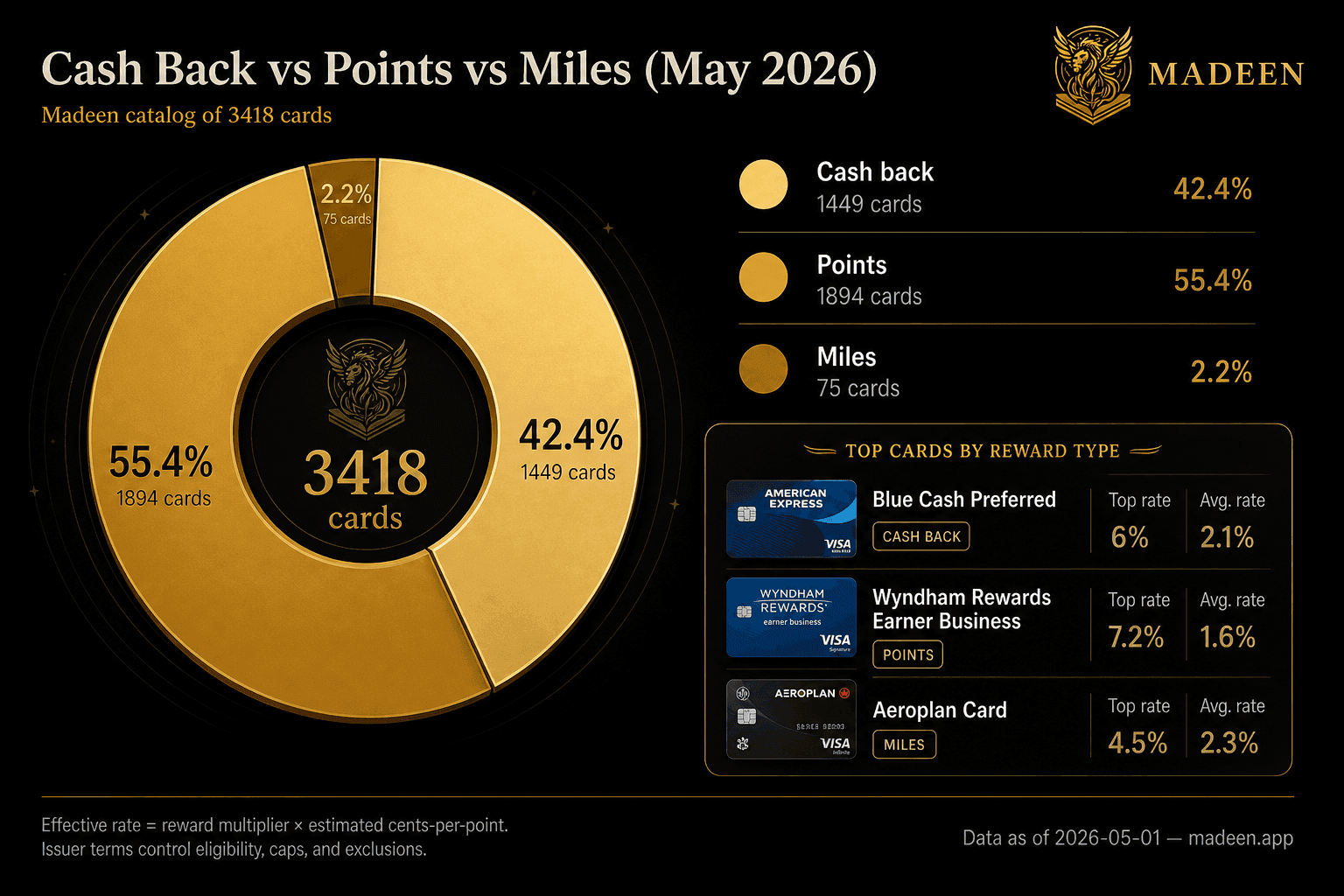
The Madeen Card Rules Index shows why this matters. Among 3,944 cards in the current catalog snapshot, 1,077 use Cash Back as the primary reward currency, 2,759 use points, and 108 use miles. Every card in that catalog has an estimated cash value per unit so Madeen can compare unlike currencies in one wallet-specific recommendation, but the estimate is still a practical assumption rather than an issuer guarantee. The methodology page explains how Madeen separates those estimates from issuer-controlled terms. For step-by-step CPP math, see how to value credit card points; for redemption paths after you earn points, see how to redeem credit card points; for a head-to-head points-card choice, compare Amex Gold vs Chase Sapphire Preferred.
Which is better, air miles or Cash back?
Cash Back is usually better when you want predictable statement credits and do not travel enough to redeem miles well. Air miles can beat Cash back when you fly regularly and redeem above one cent per mile through travel portals or transfer partners — but weak mile redemptions often underperform a flat 2% cash-back benchmark. Convert both to estimated cash return before you pick a currency.
Is it better to use points or get Cash back? {#points-or-cash-back-answer-lead}
Cash Back is usually better when you want predictable statement credits and do not want to track redemption paths. Points beat Cash back only when your realistic redemption clears one cent per point through travel portals or transfer partners you will actually use — not aspirational award examples.
If you redeem at 0.8 cents per point, a 3X category is closer to 2.4% return, which a flat 3% cash-back card can beat with less work. If you redeem at 1.25 cents, the same 3X category can clear 3.75% before fees. Pair currency math with how to value credit card points and the category caps reference when bonus rates stop applying mid-cycle.
Is 3X points better than 3% Cash back?
3X points is better than 3% Cash back only when one point is worth more than one cent after you account for redemption method, fees, and category rules.
Here is the quick comparison:
| Reward | Assumed value | Estimated return |
|---|---|---|
| 3% Cash Back | 1 cent per cent of Cash back | 3.0% |
| 3X points | 0.8 cents per point | 2.4% |
| 3X points | 1.0 cent per point | 3.0% |
| 3X points | 1.25 cents per point | 3.75% |
That table is why “points are worth more” and “Cash back is always safer” are both incomplete answers. Points can beat Cash Back when the redemption is strong and realistic. Cash back can win when the points redemption is weak, inconvenient, capped, or tied to an annual fee that the rewards do not overcome.
Is 5% Cash back the same as 5X points? {#five-percent-cash-back-vs-5x-points-answer-lead}
No. Five percent Cash Back is five cents per dollar before caps and exclusions. Five points per dollar is only equivalent if each point is worth one cent through the redemption you will actually use — and many redemptions are worth less. A 5% cash-back card with a quarterly cap can also fall behind a flat 3% card once the cap is exhausted.
Treat headline multipliers as estimates until you convert them. If you earn 5X on a category but redeem points at 0.8 cents each, the effective return is about 4%, not 5%. If you earn 5% Cash back up to a $1,500 cap and then 1%, your annual average depends on how much you spend in that category. Madeen’s catalog comparison uses estimated cash value so unlike currencies can be ranked in one wallet — see the category caps reference when a high multiplier stops applying mid-year.
Is 2x miles the same as 2% Cash back? {#two-x-miles-same-as-two-percent-answer-lead}
At one cent per mile, 2x miles equals about 2% return — roughly the same as a flat 2% cash-back card before annual fees. Miles only beat 2% Cash back when your realistic redemption clears 1.5 cents per mile through Capital One Travel, airline portals, or transfer partners you will actually use. If you redeem miles at 0.8 cents each, 2x miles is closer to 1.6% — below a no-fee 2% benchmark.
Is there anything better than Cash back? {#anything-better-than-cashback-answer-lead}
Points or miles can beat Cash back when you redeem above one cent per point through travel you would book anyway — but annual fees, category caps, and redemption friction matter. For most households, a no-fee 2% cash-back card is the honest baseline; promote flexible points or miles only when your realistic redemption path clears that bar after fees. Pair currency math with how credit card reward caps work when a high multiplier stops applying mid-cycle.
Is 2x miles or 3% Cash back better? {#two-x-miles-vs-three-percent-cash-back-answer-lead}
2x miles beats 3% Cash Back only when each mile is worth more than 1.5 cents through a redemption you will actually use. At one cent per mile, 2x miles equals about 2% return — below 3% Cash back. A flat 3% cash-back card is simpler unless you consistently redeem miles above 1.5 cents through travel portals or transfer partners.
Miles look attractive because “2X on everything” is easy to remember, but the comparison depends on redemption, not the multiplier alone. Capital One Venture’s 2X miles can work well for travelers who redeem through Capital One Travel or transfers; a no-fee 3% card can win for diners, commuters, or anyone who prefers statement credits. For a miles-vs-cash framework on everyday spend, read cash back card vs travel card before you assume miles are automatically richer.
Which cards show the difference in real life?
Use real cards as examples, not universal answers. The right card depends on what you already carry, where you spend, and how you redeem.
| Card | Primary currency | Headline earn | Annual fee | Best for |
|---|---|---|---|---|
| Citi Double Cash | Cash back (ThankYou Points) | 2% (1% buy + 1% pay) | $0 | Simple cash-equivalent benchmark |
| Chase Sapphire Preferred | Ultimate Rewards points | 3X dining, 2X travel, 1X other | $95 | Flexible points with category bonuses |
| Capital One Venture | Miles | 2X miles on every purchase | $95 | Flat miles for travelers who redeem intentionally |
Citi Double Cash is a useful cash-back benchmark because its core pitch is simple: earn 1% when you buy and 1% as you pay, with no annual fee under current issuer terms. Citi also describes the rewards as ThankYou Points that can be redeemed for Cash back in forms such as statement credit, direct deposit, or check. That makes the card a clean baseline: if a points or miles card cannot beat this kind of simple return for your use case, the extra complexity may not be worth it.
Chase Sapphire Preferred shows why points can be better for the right traveler. Chase lists category bonuses such as 3X points on dining and 2X on travel, and Ultimate Rewards points can be used through Chase redemption options. If your realistic point value is one cent, 3X dining is about a 3% estimated return before the annual fee. If your redemption is worth more, it can beat a 3% cash-back card. If you redeem poorly or do not use the travel ecosystem, the value falls.
Capital One Venture Rewards shows the miles tradeoff. The card earns unlimited 2X miles on every purchase under current issuer terms, and Capital One describes travel-focused redemption options such as covering eligible travel purchases and using transfer partners. That can be attractive if you travel and redeem miles intentionally. If you want cash-like simplicity or rarely use travel redemptions, a miles card may be less straightforward than a flat cash-back card.
For flat-rate cash-back head-to-heads, compare Capital One Quicksilver vs Citi Double Cash, Citi Double Cash vs Wells Fargo Active Cash, and Chase Freedom Unlimited vs Discover it. Inside Chase, see Freedom Flex vs Freedom Unlimited and Citi Custom Cash vs Freedom Flex for category-card tradeoffs. For how quarterly 5% calendars and activation caps work, read how credit card rotating categories work.
How much is 50,000 air miles worth in dollars? {#fifty-thousand-miles-worth-answer-lead}
Fifty thousand air miles are often worth about $500–$750 at a one-cent-per-mile baseline for statement credits or travel purchase erasers — but airline award seats can swing from roughly $300 to $1,000+ depending on route, taxes, and the cash fare you would have paid. Convert using the redemption path you will actually book, not a headline transfer example, before you choose a 2X miles card over a flat 2% or 3% cash-back benchmark.
How much money is 1,000 points on a credit card? {#thousand-points-worth-answer-lead}
One thousand credit card points are often worth about $10 when each point redeems at one cent — typical for Cash back, statement credits, or many travel-portal redemptions. Airline miles, hotel points, and transfer-partner awards can swing higher or lower depending on route, taxes, and availability, so the same 1,000 points might be worth $5–$30 in practice.
Convert using the redemption path you will actually choose, not a headline example. If you earn 1,000 points on a 5X category but redeem at 0.8 cents each, the effective return is $8, not $50. Pair this check with how to value credit card points and the category caps reference when bonus categories stop applying mid-cycle.
What is the #1 rule of credit card rewards? {#number-one-rewards-rule-answer-lead}
The first rule of credit card rewards is to pay on time and avoid carrying balances that accrue interest. Category bonuses, welcome offers, and miles multipliers assume you are not paying APR or late fees that wipe out months of earn. Rewards optimization is a layer on top of sound payment habits — not a substitute for them.
If you are comparing currencies before you add another card, read how credit card late fees work and what a credit card grace period is so headline earn rates stay meaningful.
How should you value credit card points?
Value points based on your likely redemption, not the best redemption someone else can find.
Use this conservative order:
- Cash or statement-credit value: Easy to understand, but sometimes lower than travel value.
- Travel portal value: Useful when you would book that travel anyway and the portal price is competitive.
- Transfer-partner value: Potentially higher, but only if you know how to use airline or hotel partners.
- Gift cards, merchandise, and checkout redemptions: Convenient, but values can vary and may be weaker.
- Aspirational examples: Good for learning, but risky as a default assumption.
If you are not sure, start with one cent per point for flexible points only when the issuer’s redemption options support that assumption for your use. For airline and hotel miles, be even more careful. Their value can depend on award availability, route, hotel category, taxes, fees, expiration rules, and whether you would have paid cash for the same trip.
How do redemption options change Cash Back value?
Cash back is easiest to compare when the redemption option acts like cash. Statement credits, bank deposits, and checks are usually the cleanest comparison points because they can be translated into cents per dollar with little extra judgment. Gift cards, shopping checkout redemptions, merchandise, and travel portals can be useful, but they may change the real value or lock you into a channel you would not otherwise use.
That matters for cards that advertise Cash back but issue rewards as points. Citi Double Cash is a good example: the card is marketed around cash-back earning, but Citi describes the rewards as ThankYou Points that can be redeemed in several ways. If you redeem those points for a strong cash-equivalent option, the comparison stays simple. If you choose a weaker redemption, the return is lower than the headline rate suggests.
The CFPB has also warned that rewards programs can create problems when redemption terms are unclear, benefits change after consumers make decisions, or advertised rewards are hard to actually use. That is why a cash-equivalent comparison should include both the earn side and the redemption side. A high multiplier is not enough if the practical redemption path is weaker than cash.
How do annual fees change the comparison?
Annual fees lower the effective return unless the card’s extra rewards and benefits exceed the fee. A $95 card can still be worth it, but the points or miles need to do more work than a no-fee cash-back card.
For example, a no-fee 2% cash-back card and a $95 2X miles card may look similar on headline earn rate. The miles card wins only if your redemptions, benefits, and travel fit create enough extra value to cover the fee. If you redeem the miles weakly or do not use the benefits, the no-fee cash-back benchmark may be better.
For a deeper fee framework, read Is a Credit Card Annual Fee Worth It?. If interest charges would erase rewards, pair currency math with how credit card late fees work and what a credit card grace period is. The important point here is that reward currency and annual fee should be evaluated together, not separately.
Why does Madeen use estimated cash value?
Madeen uses estimated cash value so the app can compare cards in one practical ranking at checkout. A grocery purchase should not require you to manually compare 3% Cash Back, 3X bank points, 2X airline miles, and a base 2% card in your head.
The estimate lets Madeen translate each eligible reward rule into a common unit. That is especially useful because the catalog includes all three major reward currencies. In the current catalog, points are the most common primary currency, Cash back is close behind, and miles are less common but still important for travel cards. A common estimate keeps the recommendation readable while still reminding you that issuer terms and your redemption habits are authoritative.
Madeen does this locally. You select the cards you carry, choose the relevant purchase category where available, and Madeen compares local reward rules without asking for your bank login, card numbers, or transaction history. For category-specific hub guides that stack with currency math, see which credit card for groceries (August 2026 hub refresh), best credit card for Walmart, and which credit card for gas. When quarterly caps change which currency wins, pair this guide with how credit card reward caps work. For the product mechanics, read how a credit card optimizer can work without bank login; for rival optimizer apps that automate linked accounts or checkout, see CardPointers alternatives, MaxRewards vs Kudos and Kudos vs MaxRewards; for the broader launch context, read why Madeen does not ask for your bank login.
What is the safest way to choose between Cash back, points, and miles?
Choose the reward currency that you will redeem well with the least unnecessary complexity.
Use this checklist:
- Start with your best no-fee cash-back card as the baseline.
- Convert points and miles into a realistic estimated return.
- Subtract annual fees unless benefits clearly offset them.
- Check category caps, activation rules, and merchant exclusions.
- Prefer points or miles only when you understand the redemption path.
- Revisit the decision when issuer terms or your travel habits change.
Issuer terms are authoritative, and card rewards can change. Before applying for or relying on a card, review the issuer’s current rewards, fees, redemption rules, caps, exclusions, and benefit terms.
For category decisions where caps change the math, pair this framework with how credit card reward caps and limits work and the refreshed cell phone bill and internet bill utility guides when recurring bills stack with category bonuses. When miles are your currency, compare Capital One Venture vs Venture X before you assume a higher annual fee buys better everyday earn. When gas is your biggest variable spend, the best gas credit card hub, August gas monthly spoke, and are gas credit cards worth it show how cash-back caps beat headline multipliers at the pump. For groceries and travel wallets splitting currencies, compare the August groceries spoke and August travel spoke. For dining wallets choosing between flat Cash back and Membership Rewards, compare which credit card for dining before you assume 4X always beats 3%. For how cash-back earn and redemption work before you compare currencies, read how credit card cash back works. For a step-by-step CPP formula when comparing points cards to Cash Back, see how to value credit card points. For the card-type fork before currency math, read cash back card vs travel card and evaluate a welcome bonus in cash-equivalent terms. Rewards only keep full value when you pay statement balances — read what a credit card grace period is and why minimum payments erode returns. If merchant coding changes which category bonus applies, read how merchant category codes affect credit card rewards. For entertainment purchases where caps and coding collide, see the best credit card for sports tickets hub. For dining-heavy wallets choosing Cash back vs Membership Rewards, compare Capital One Savor vs Amex Gold. If you are still choosing your first rewards card, compare secured vs unsecured credit cards and Chase Freedom Flex vs Discover it before you optimize redemption math.
Related encyclopedia topics
Frequently asked questions
How do you compare cash back, points, and miles for a new card?
Convert each reward to estimated cash return using earn rate times realistic cents-per-point, then subtract annual fees and check category caps. Cash back is the baseline; points or miles win only when your actual redemption path clears that bar.
Is 3X points better than 3% cash back?
3X points is better than 3% cash back only if each point is worth more than one cent to you after fees, caps, and redemption limits. If each point is worth one cent, 3X and 3% are roughly equal before other costs.
How should you value credit card points?
Use the redemption you will realistically choose, not the highest advertised possibility. Cash, statement-credit, travel-portal, and transfer-partner redemptions can all produce different values.
Why does Madeen use estimated cash value?
Madeen uses estimated cash value so cash back, points, and miles can be compared in one checkout-time ranking. The estimate is a practical comparison tool, not a promise of what every redemption will be worth.
Should you always choose points or miles for travel?
No. Points and miles can be valuable for travel, but cash back may be better if you want simplicity, avoid annual fees, or do not redeem through the travel channels that make the points valuable.
Which cash back redemption option is easiest to compare?
Statement credits, bank deposits, and checks are usually easiest to compare because they behave most like cash. Gift cards, checkout redemptions, travel portals, and transfer partners need a separate value assumption.
Is it better to have cash back or miles?
Cash back is usually better when you want simple, flexible rewards and do not travel often enough to redeem miles well. Miles can beat cash back when you fly regularly and redeem at strong value, but weak mile redemptions often underperform a flat 2% cash-back card.
Is 5% cash back the same as 5X points?
No. Five percent cash back is five cents per dollar before caps and exclusions. Five points per dollar is only equivalent if each point is worth one cent to you through the redemption you will actually use—and many redemptions are worth less.
What's the difference between cash back, points, and miles?
Cash back is stated in cents per dollar and is easiest to compare. Points are flexible bank currencies whose value depends on redemption path. Miles are usually airline or hotel currencies tied to travel redemptions. Convert each to an estimated cash value before comparing headline earn rates.
Are points or miles better than cash back?
Points or miles can beat cash back when you redeem at strong value and travel enough to use them. Cash back wins when you want simple statement credits, avoid annual fees, or redeem points below one cent. Neither is universally better — compare estimated return for your wallet.
Is 2x miles or 3% cash back better?
2x miles beats 3% cash back only when each mile is worth more than 1.5 cents through a redemption you will actually use. At one cent per mile, 2x miles equals about 2% return — below 3% cash back. A flat 3% cash-back card is simpler unless you consistently redeem miles above 1.5 cents.
How to compare cashback vs miles?
Convert each earn rate to estimated cash return: multiply points or miles by the cents-per-point you will realistically redeem, then compare to a flat cash-back benchmark like 2%. Include annual fees, category caps, and whether you will actually use travel redemptions before calling miles the winner.
What's better, 1.5 cash back or 1.25 miles?
1.5% cash back is better unless each mile is worth more than 1.2 cents through a redemption you will actually use. At one cent per mile, 1.25x miles equals about 1.25% return — below 1.5% cash back. Miles only win when your typical redemption clears that break-even.
Is it better to get a credit card with miles or cash back?
Cash back is better when you want simple statement credits and predictable value. Miles can beat cash back when you travel regularly and redeem above one cent per mile through portals or transfer partners. Match the currency to the redemption you will actually use — not the highest advertised multiplier.
Is it better to use points or get cash back?
Cash back is better when you want flexible statement credits and do not want to hunt for award seats or portal deals. Points can beat cash back when you redeem above one cent per point through travel portals or transfer partners you will actually use. Convert both to estimated cash return before you assume points are automatically richer.
Which is better, air miles or cash back?
Cash back is better for simplicity and flexible statement credits. Air miles beat cash back only when you fly often and redeem above one cent per mile through travel portals or transfer partners. At one cent per mile, a flat 2% cash-back card often matches or beats a 2X miles card with less complexity.
Is 2x miles the same as 2% cash back?
At one cent per mile, 2x miles equals about 2% return — roughly the same as 2% cash back before fees. Miles only beat 2% cash back when your realistic redemption clears 1.5 cents per mile through travel portals or transfer partners you will actually use.
Is there anything better than cashback?
Points or miles can beat cashback when you redeem above one cent per point through travel you would book anyway — but only after annual fees, caps, and redemption hassle. For most households, a no-fee 2% cash-back card is the honest baseline; promote points or miles only when your redemption path clears that bar.
Which is better, miles or cashback?
Cashback is better when you want simple statement credits and predictable cents-per-dollar value. Miles beat cashback only when you travel regularly and redeem above one cent per mile through portals or transfer partners. At one cent per mile, a flat 2% cash-back card often matches a 2X miles card with less complexity.
How much is 50,000 air miles worth in dollars?
Fifty thousand air miles are often worth about $500–$750 at a one-cent-per-mile baseline for statement credits or travel erasers, but airline award seats can swing from $300 to $1,000+ depending on route, taxes, and cash fare. Convert using the redemption you will actually book — not a headline example — before you choose miles over a flat 2% or 3% cash-back card.
How much money is 1,000 points on a credit card?
One thousand credit card points are often worth about $10 when redeemed at one cent per point for cash or statement credit, but airline, hotel, and transfer-partner redemptions can be worth more or less. Convert points using the redemption you will actually use before comparing earn rates.
What is the #1 rule of credit card rewards?
Pay your statement balance on time and in full whenever possible. Interest charges and late fees erase reward value faster than category bonuses create it — rewards math assumes you avoid carrying balances and penalty APR.
Is it better to have cash back or miles?
Cash back is better when you want simple statement credits and predictable value without tracking redemption paths. Miles beat cash back only when you travel regularly and redeem above one cent per mile through travel portals or transfer partners you will actually use. At one cent per mile, a flat 2% cash-back card often matches a 2X miles card with less complexity.
Sources and notes
- Madeen analysis Madeen card catalog reward-currency analysis - Madeen Accessed 2026-07-02.
- Issuer terms Citi Double Cash Credit Card - Citi Accessed 2026-05-01.
- Issuer terms How to Redeem Citi Double Cash Credit Card Rewards - Citi Accessed 2026-05-01.
- Issuer terms Chase Sapphire Preferred Credit Card - Chase Accessed 2026-05-01.
- Issuer terms Chase Ultimate Rewards: How Our Program Works - Chase Accessed 2026-05-01.
- Issuer terms Capital One Venture Rewards Credit Card - Capital One Accessed 2026-05-01.
- Issuer terms How to Earn and Redeem Capital One Miles - Capital One Accessed 2026-05-01.
- Regulator Consumer Financial Protection Circular 2024-07: Design, marketing, and administration of credit card rewards programs - Consumer Financial Protection Bureau Accessed 2026-05-21.